
In-Depth Analysis of the Oopbuy Spreadsheet: Methods for Uncovering Hidden, High-Quality Products
With Oopbuy Spreadsheet, users can compare suppliers, track discounts, and quickly discover profitable product opportunities worldwide. Oopbuy Spreadsheet improves decision-making by consolidating product insights and highlighting the best-value deals in one place.
6/22/20263 min read
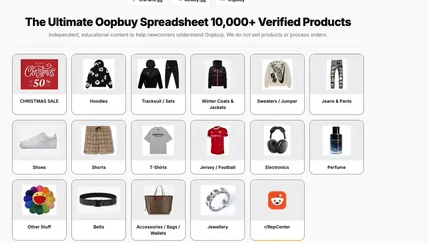
Oopbuy Spreadsheet Deep Analysis: Hidden High-Quality Product Discovery Methods (2026 SEO Guide)
In the evolving world of cross-border e-commerce, the ability to identify hidden high-quality products early is a major competitive advantage. The Oopbuy Spreadsheet has become a structured data system that helps sellers and buyers organize sourcing information, evaluate product quality signals, and discover undervalued opportunities before they become mainstream.
This article provides a fully original SEO-optimized deep dive into how Oopbuy Spreadsheet can be used to systematically uncover hidden high-quality products.
What Is Oopbuy Spreadsheet?
The Oopbuy Spreadsheet is a structured product intelligence framework designed for managing overseas sourcing and shopping data in a centralized system.
Instead of relying on manual browsing across platforms, users collect and organize all product information into a unified spreadsheet that enables:
Product sourcing tracking
Supplier comparison
Price monitoring and analysis
Order and logistics management
Hidden product opportunity discovery
It transforms fragmented e-commerce data into a structured decision-making system.
Why Hidden High-Quality Products Are Valuable
Hidden high-quality products are items that:
Offer strong product durability and reliability
Have low market visibility but high customer satisfaction
Maintain stable long-term demand
Are not yet saturated by competitors
Provide consistent profit margins
These products are especially valuable because they allow early entry before mainstream adoption.
Core Strategy Behind Oopbuy Spreadsheet
The Oopbuy Spreadsheet method is based on one principle:
Structured data + quality signals + timing = sustainable product advantage
Instead of guessing trends, users rely on measurable indicators such as:
Supplier consistency
Product return rate behavior
Price stability across listings
Demand growth patterns
Customer feedback trends
Step 1: Building a Structured Product Intelligence System
To discover hidden high-quality products, your spreadsheet must go beyond basic tracking.
Essential Columns:
Product name and variation
Supplier/source platform
Purchase cost
Shipping method and cost
Quality score rating
Return/refund rate
Demand trend indicator
Estimated profit margin
This structure enables quality-driven filtering instead of price-only decisions.
Step 2: Identifying Quality Signals in Products
High-quality hidden products often show indirect but strong signals.
Key indicators include:
High supplier rating consistency
Low defect or complaint rates
Stable pricing over time
Repeat purchase behavior across buyers
Positive multi-platform reviews
These signals are more reliable than temporary sales spikes.
Step 3: Supplier Reliability Analysis
A key advantage of Oopbuy Spreadsheet is long-term supplier tracking.
Evaluate suppliers based on:
Fulfillment accuracy rate
Shipping consistency
Inventory stability
Product defect frequency
Communication responsiveness
Reliable suppliers often indicate long-term sustainable product quality.
Step 4: Product Lifecycle Positioning
Every product follows a lifecycle:
Introduction
Growth
Maturity
Decline
Hidden high-quality products are usually found in:
Late introduction or early growth stages
At this stage:
Product quality is stable
Competition is still low
Demand is starting to increase
Step 5: Demand Stability vs. Short-Term Spikes
A critical filtering method is distinguishing stable demand from temporary hype.
Stable Demand (Preferred):
Consistent order flow
Gradual growth pattern
Long-term usability
Spike Demand (Risky):
Sudden viral exposure
Short-term purchasing behavior
Unstable long-term value
Hidden high-quality products usually belong to the stable demand category.
Step 6: Multi-Source Validation Strategy
To ensure accuracy, advanced users validate products across multiple sources:
Domestic sourcing platforms
International marketplaces
Customer review systems
Community feedback channels
If multiple sources confirm consistent quality, confidence in the product increases significantly.
Step 7: Profitability with Quality Adjustment
Unlike basic spreadsheets, Oopbuy Spreadsheet users apply quality-adjusted profit analysis.
Key factors include:
Total landed cost (product + shipping + fees)
Expected resale price
Return risk cost
Customer retention potential
Quality-driven price premium
This produces a more realistic profitability estimate.
Step 8: Product Scoring System for Selection
Advanced users apply scoring frameworks to rank products objectively.
Example scoring categories:
Product quality (0–10)
Supplier reliability (0–10)
Demand stability (0–10)
Profit margin (0–10)
Market saturation level (0–10)
Interpretation:
40–50 → Strong hidden high-quality product
30–39 → Watchlist candidate
Below 30 → Exclude
Step 9: Risk Filtering System
To avoid poor decisions, users filter out high-risk products such as:
High return-rate items
Unstable suppliers
Highly volatile pricing products
Low repeat purchase behavior
Poor cross-platform reputation
Risk control ensures long-term sustainability.
Step 10: Long-Term Tracking Strategy
Hidden high-quality products are not one-time discoveries.
Maintain continuous tracking of:
Quality consistency over time
Supplier performance trends
Customer satisfaction evolution
Seasonal stability patterns
This transforms Oopbuy Spreadsheet into a long-term intelligence system.
Common Mistakes Users Make
Many users fail because they:
Focus only on low prices instead of quality
Ignore supplier historical performance
Rely on short-term trending data
Do not track return rates
Lack consistent data updates
True success requires structured discipline.
Best Practices for Oopbuy Spreadsheet Users
To maximize effectiveness:
Update data regularly (daily or weekly)
Standardize scoring metrics
Track supplier history continuously
Separate test and core products
Combine qualitative and quantitative analysis
Who Should Use This System?
The Oopbuy Spreadsheet strategy is ideal for:
Cross-border e-commerce sellers
Dropshipping operators
Product sourcing analysts
Wholesale buyers
Data-driven resellers
Final Thoughts
The Oopbuy Spreadsheet is more than a tracking tool—it is a structured intelligence framework for identifying hidden high-quality products in global markets.
In 2026, competitive advantage no longer comes from speed alone, but from accuracy, data structure, and predictive insight.
By combining supplier analysis, demand stability tracking, and quality scoring systems, users can consistently identify durable, profitable products before they become widely competitive.
oopbuy finds
Services
Support
contact@oopbuyyupoo.com
© 2025. All rights reserved.